While I was working on the nursery floor, I was messing with the pin hinges in the door and accidentally poked the bottom pin through the front of the door, mangling the hole beyond repair. (Hence the chip in the paint.) So before I could continue with the nursery walls, I had to make another door. Two steps forward, one step back with this house.
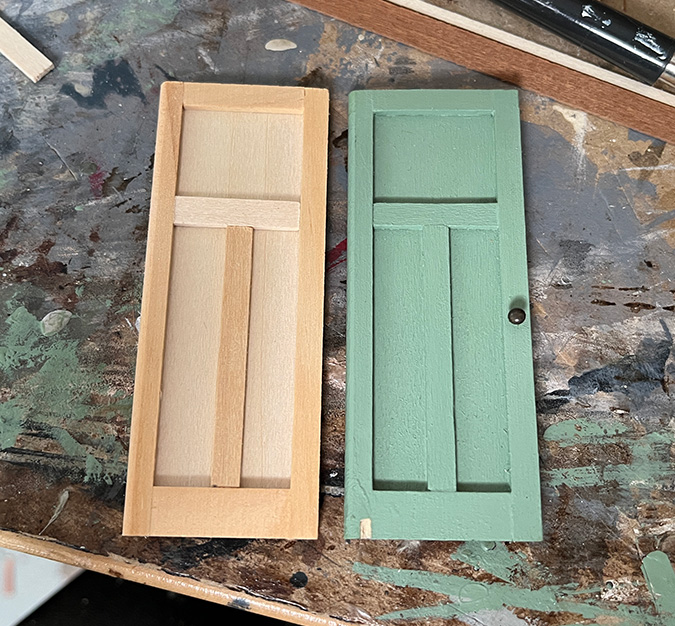
These doors are made from oval light doors that used to be available on Real Good Toys’ website, but no longer are. This post shows how I make them.
The first door was in a frame I’d made myself out of strip wood. To mitigate future pin-hinging catastrophes, I decided to pull off those pieces and instead use the frame that came with the door — that way the hole and pin at the top were guaranteed to line up. I cut off the threshold at the bottom to hinge the door directly into a floorboard.
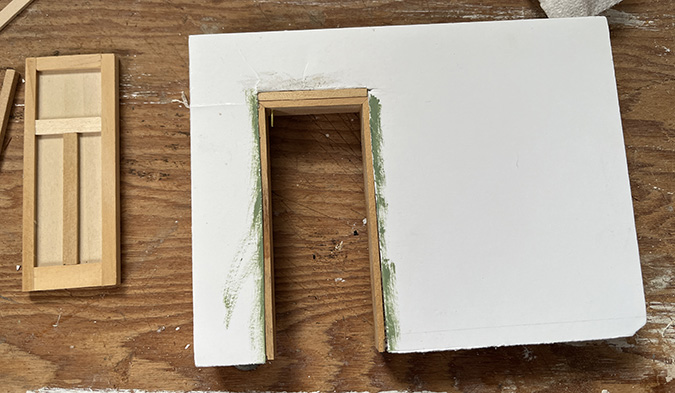
The frame is deeper than my strip wood pieces were, so it sticks out in the back. I used the pieces I’d just pulled out of the frame as shims.
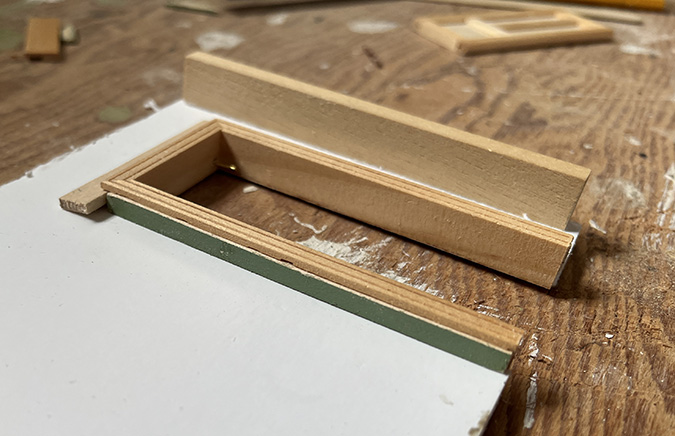
The foamcore was getting beat up from all of my messing with it. I covered it with scrapbook paper to have a smooth surface to glue wallpaper to.
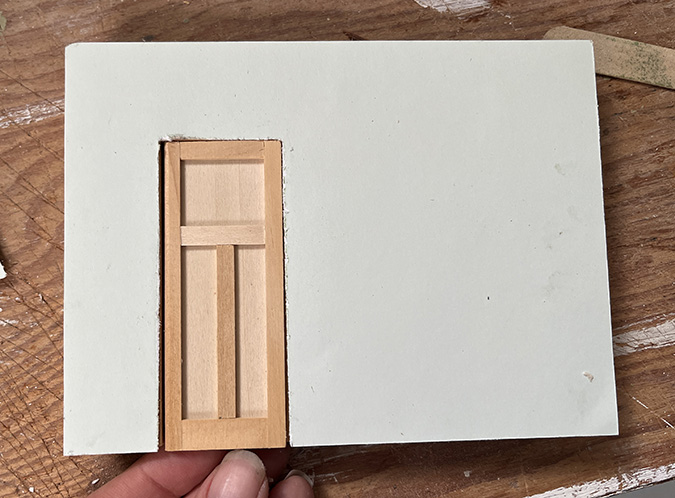
Next I painted the new door and the frame.
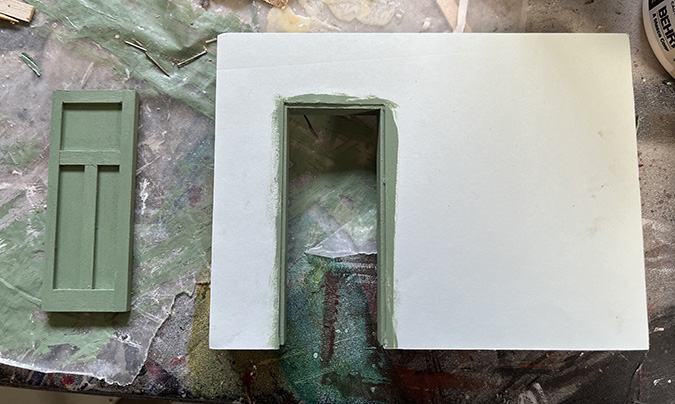
And now I was ready to wallpaper. I’d picked this paper out when I started working on the nursery last summer.
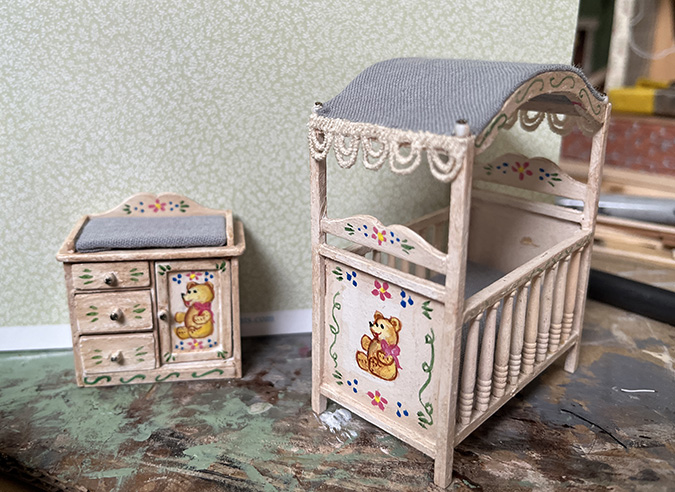
Since then, I’d bought this 1:12 Bradbury & Bradbury wallpaper from Miniatures.com, and I was tempted to use it instead.
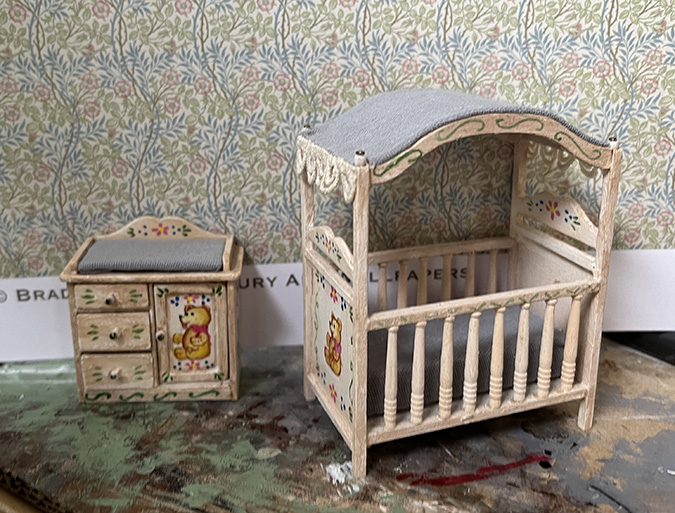
This happens to be the same design I tried (and failed) to print myself for the Queen Anne Rowhouse, but the design is bigger since it’s 1:12 scale. I think the colors look really nice with the blue fabric on the nursery furniture, but the design felt a little too busy. I might use it in one of the bedrooms instead.
After spraying the wallpaper with UV-resistant spray and letting it dry, I cut a piece slightly longer than the false wall. The excess will wrap around to the side walls.
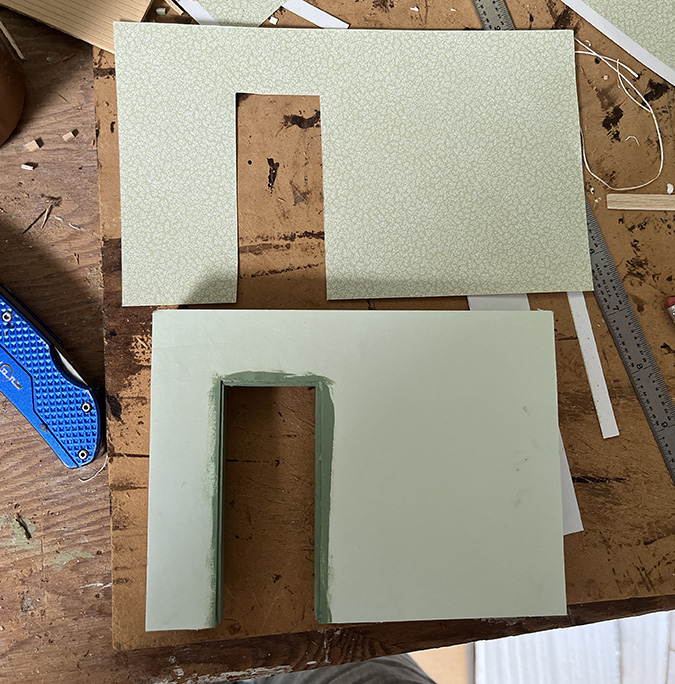
The last time I did this, I tried achieving neat folds at the edges by scoring these side pieces and accidentally sliced through one of them. Not wanting to repeat that mistake, this time I slipped the wall back into place and folded them.
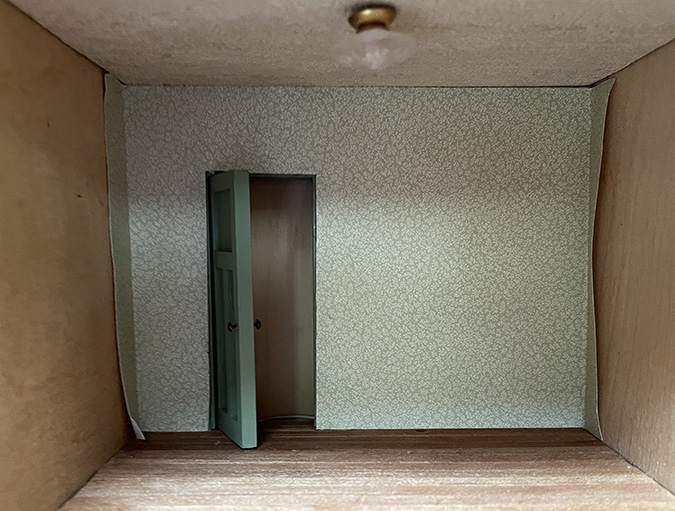
Now it was time to pin hinge the door. I positioned the threshold I’d previously cut off the frame on top of a floorboard to figure out how close the hole should be to the front of the floorboard. Then I held the floorboard against the bottom of the false wall, with the pin hinge in, and cut the sides of the floorboard down to the width of the false wall. (If I’d cut the floorboard down first, it would have been harder to get the hole in the right place.)
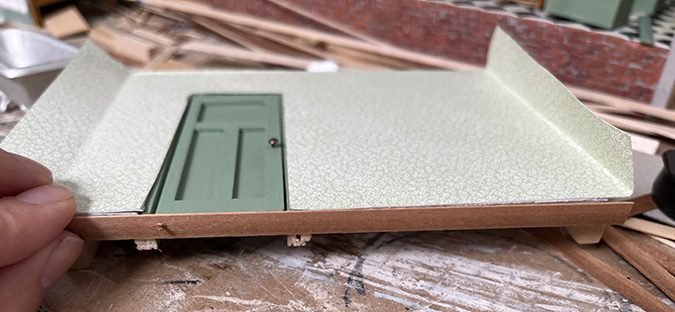
Since the threshold is taller than a floorboard, the pin hinge stuck out the bottom. I didn’t want to try to push the pin in farther and risk messing up this door like I did the last one, so instead I used wire cutters to clip off the extra bit of pin that was sticking out.
I popped the wall back in to make sure everything was good.
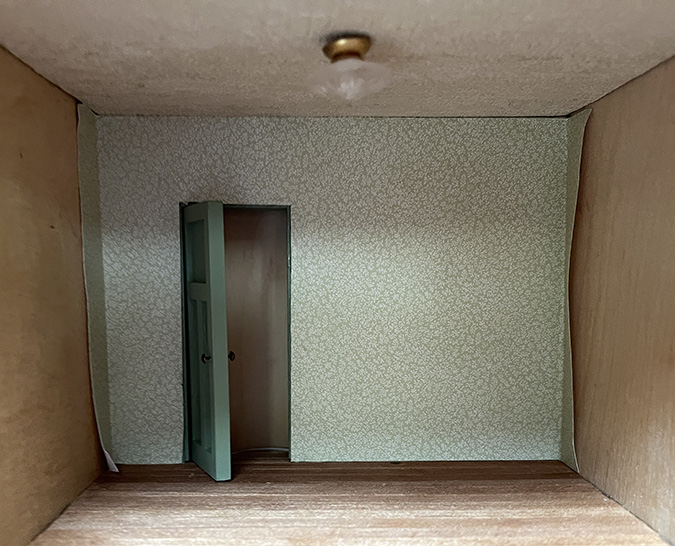
This looks so much more realistic than the thick threshold that comes with the door. (Weird lighting on this picture!)
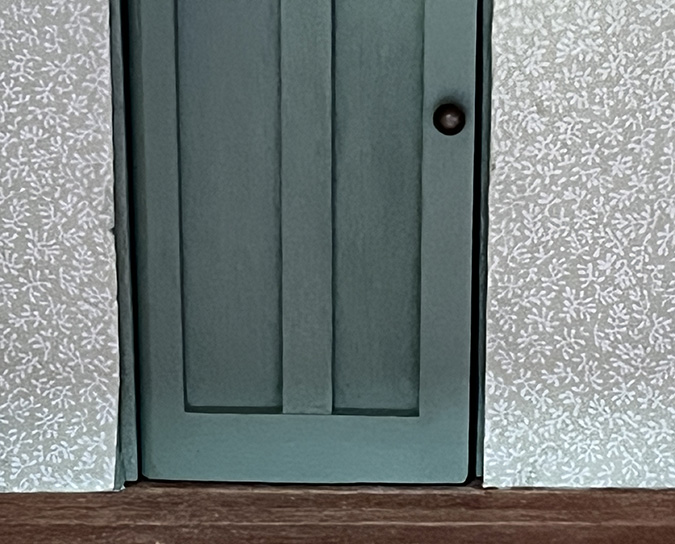
I’m planning to put outlets in the other bedrooms to plug in bedside lamps, in addition to the ceiling light, but I couldn’t figure out a good way to do that in the nursery. The outlet could have been hidden under the crib, but there wouldn’t be a good spot nearby for a lamp.
Instead I decided to add a sconce to the wall. I put a piece of molding up against the door and centered the sconce between it and the corner.
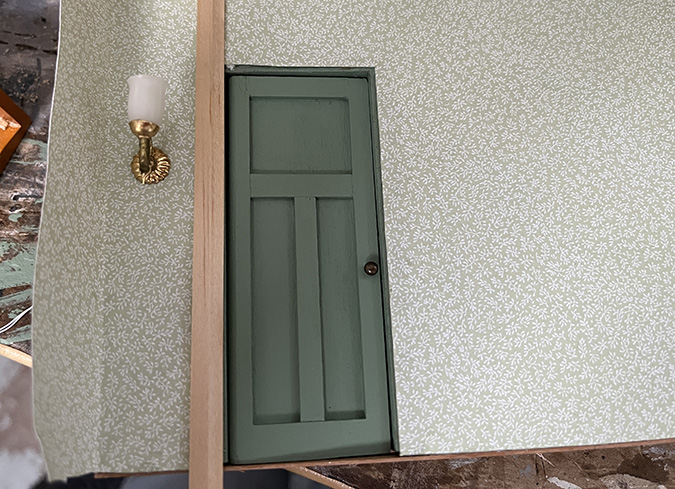
I then added a plug and plugged it into one of the outlets hidden behind the door. Like the ceiling lights, the bulb isn’t removable, but if it ever burns out it will be easy (or at least not impossible) to remove the fixture and get a new light in there.
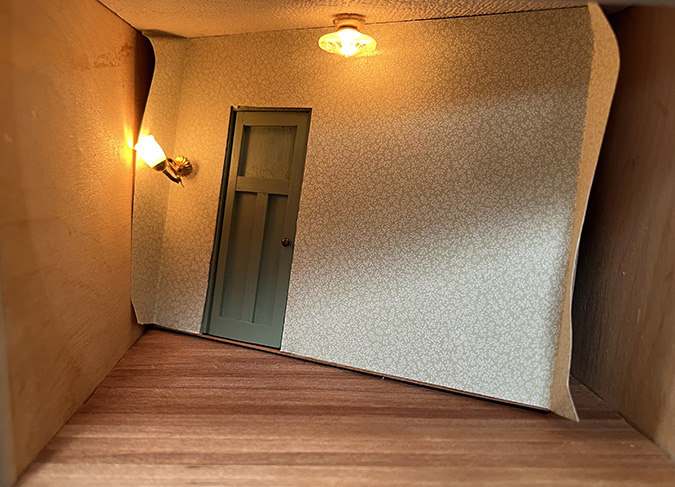
I didn’t want to push the wall in all the way, because adding the floorboard made it a very tight fit and I don’t want it to get stuck in place before I’m ready. The molding will be much easier to cut and glue in with the wall outside of the house — that’s my next task.
 Emily is a freelance writer, miniaturist, and adventure game enthusiast.


Nice work with the door. I love that 1 inch scale wallpaper – I hope you can use it. I find the half scale wallpaper prints too busy and hard to see the pattern sometimes.
Thanks! Yeah, I’ve found several 1:12 prints that work well in 1:24, but it can be hard to tell without seeing it in person. The 1″ marks displayed on the wallpaper online don’t really help me visualize the scale.
The wall sconce light gives it an elegant look, very nice. Definitely seeing the wallpaper in person makes a big difference as to what scale will work. I now have shifted to 1/24 scale & have even used certain wallpapers for flooring (really depends on the print). I do like your final choice & agree with you that the 1/12 paper was too busy with the nursery furniture.
Thanks for the feedback. I was thinking the busier paper might look good with wainscot. There’s a thick border at the top of the paper that could possibly be used on the bottom as wainscot instead.
Very inspiring. You give me confidence in figuring out how to fix oopsies. Thank you.
Love that you’re still doing this! Great stuff. =)
Hello! Blast from the past! Great to “see” you here. :)