The Den of Slack

emilymorganti.com

Finishing the sink area

Back in August, I thought building a cabinet for the Mansard Victorian’s kitchen sink would be a quick diversion before I dove into finishing the nursery. Little did I know it would take me the rest of 2025 to finish. Daisy’s gift to me was spending three hours calm in her crate today while I (mostly) finished the project — it’s a Christmas miracle!

The first task on the to-do list was to hide the cracks of light showing above the upper cabinets.

Since covering the top of the cabinet with crown molding hadn’t worked, I decided instead to build a fake ceiling in front of the cabinet. I found a piece of wood thick enough to cover the crack.

Like with the crown molding, you can see light over this. The opening isn’t square and because of how the bump-out is situated, I just couldn’t figure out why the wood wouldn’t fit flush with the ceiling.

But that’s okay, because now the crack will be hidden by the trim.

I covered the wood with a piece of the scrapbook paper I used on the walls, wrapping it around the end to make sure no bare wood would be visible.

The edge is a bit sloppy, but it’ll be covered up.

Continue reading

Stained glass kitchen window and a light over the sink

I mentioned at the end of my last post that the doors on the over-the-sink cabinets didn’t close all the way and I wasn’t sure I wanted to mess with them anymore.

Well, I messed with them. I removed each shelf, shaved off a small amount of the back using a utility knife, and glued them back in. Easy fix, really.

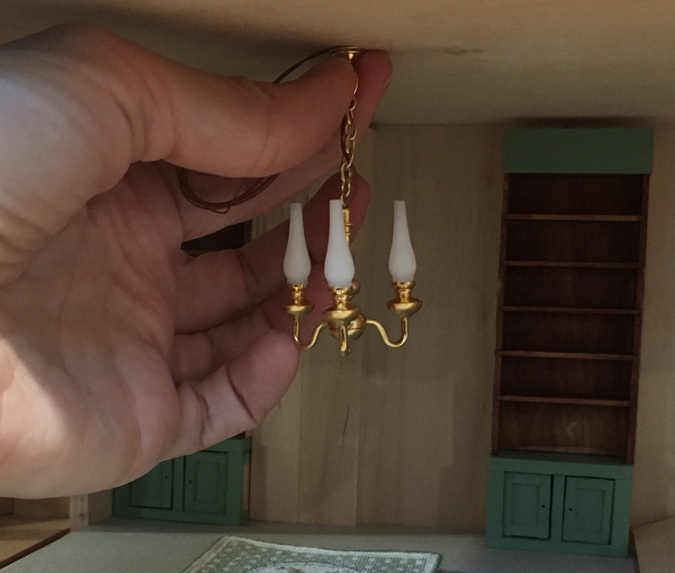
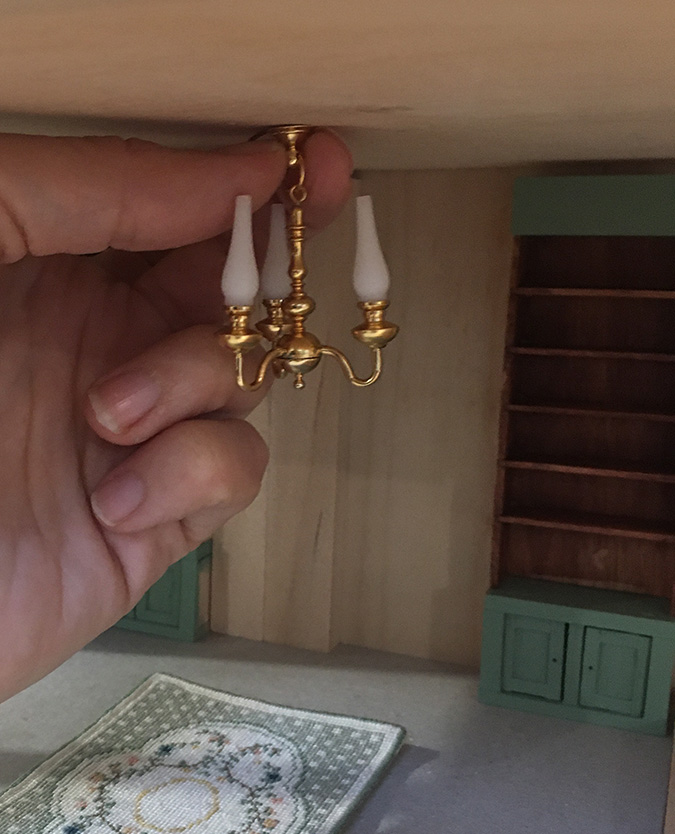
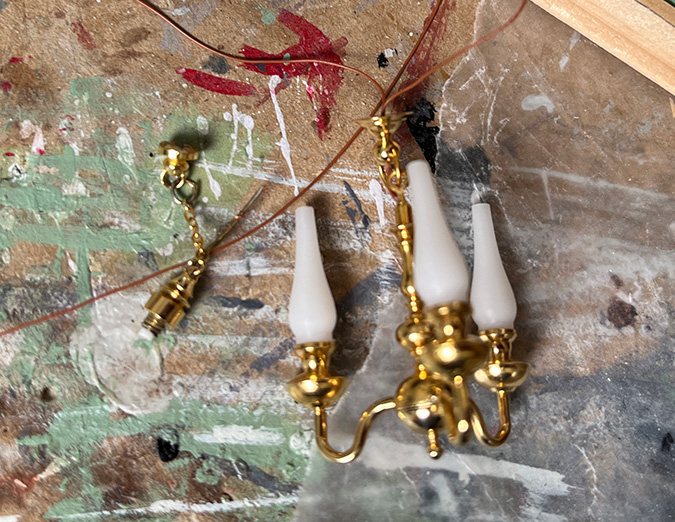
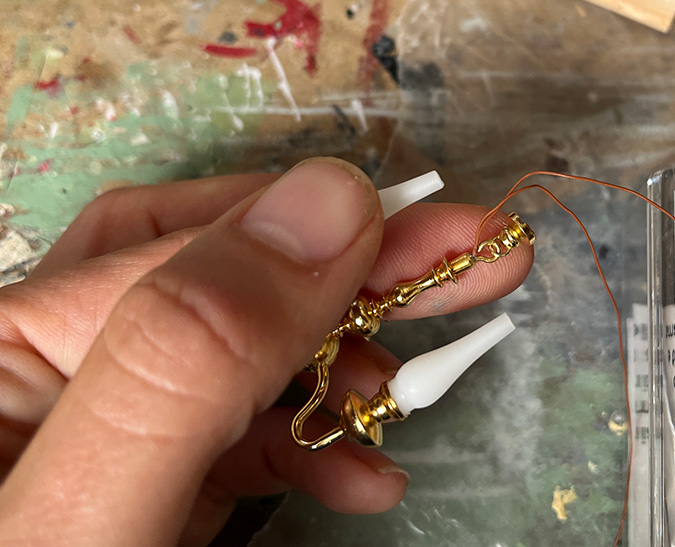
Moving on. As shown here, I started adding lights to the kitchen two and a half years ago (yikes). I had planned to use this light over the sink, made from two Houseworks fixtures that I frankensteined together.

The wire is hidden under the roof, and feeds into the nursery where it will be plugged in. (Oh yeah, that’s why I went down this sink cabinet rabbit hole three months ago… I wanted to finish the kitchen electricity so I could work on the nursery…)

Later I moved that fixture out into the room and put this one in the bump-out.

But that light gets in the way of the upper cabinets. Time for a new plan. I decided to insert a Cir-Kit screw-base bulb socket behind the cornice on the uppers, same as I did with the stove hood.

The piece of trim glued across the top of the cabinets doesn’t go all the way back to the wall. This pencil line shows where that trim ends. I have just enough space to drill a hole for the fixture.

I hadn’t considered that this fixture is a little taller than the thickness of the top of the bump-out, so the back side sticks out. I can add strip wood around the edges of the bump-out to make it a little taller. This will provide a cavity under the roof where I can leave some excess wire, allowing me to pull the fixture out into the kitchen if I need to change the bulb.

Inside, the bulb will be hidden behind the cornice.

Now it’s time to do something about that big gaping window hole. After a lot of pondering, looking through my stash at different windows, and looking online at pictures of kitchens, I got the idea to make a stained glass window out of laser-cut mullions (sold by D’s Miniatures on eBay).

Continue reading

Uppers continued, plus backsplash

I’ve slowly been making progress on the cabinets around the sink. It’s been frustrating, hence the very long delay in getting this post up.

Since the bump-out is hard to see and reach into, I decided to glue the backsplash tiles onto a piece of wood that “stands up” behind the cabinet — this way I don’t have to worry about trying to glue in two separate backsplash pieces in exactly the right spot to make them level.

I started by tracing around the top of the sink.

Then I drew lines to indicate where the window trim would go.

Here’s what I ended up with. I thought it would be easier to glue the trim to this piece of wood than to the wall. The XXX part is a sliver that will need to be cut out above the bottom piece of trim.

I started at the top edge so I wouldn’t end up with slivers under the cabinets. These tiles are made from scrapbook paper cut with a 1/4″ x 1/8″ punch (read more about it here).

Since this piece of wood goes behind the cabinet and sink, the tiles run behind the sink corner and the countertop, so there’s a neat transition.

And here are both sides finished. I trimmed the tiles hanging over the edges with nail scissors.

Continue reading

« Older posts

© 2025 The Den of Slack

Theme by Anders NorenUp ↑